📰
News
CRC-N President in Canada To Honour Rev. Jan Boer
📅 Sep 12, 2026
👤 System Administrator
👁️ 5 views
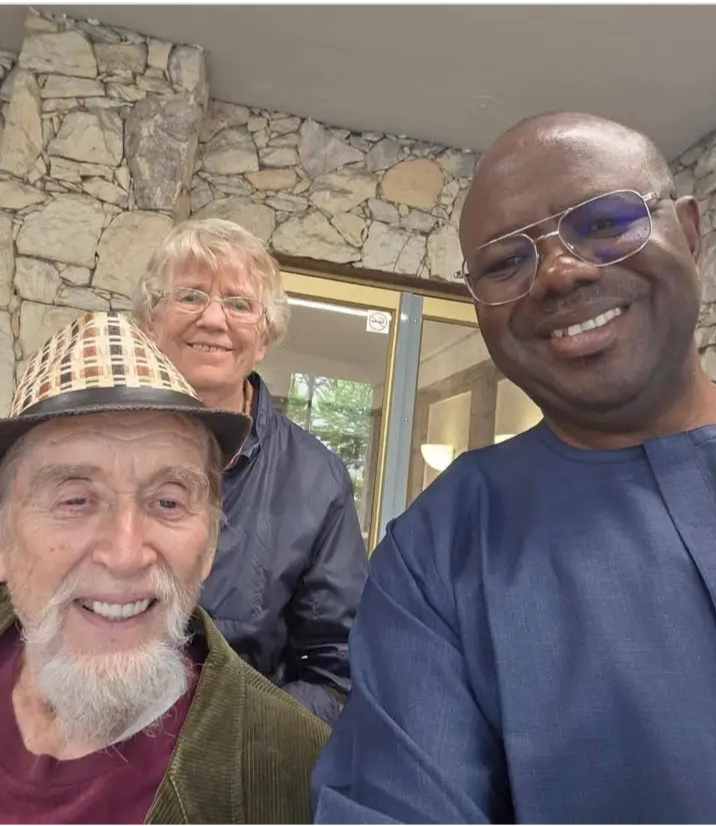
Rev. Dr. Isaiah Magaji Jirapye Returns To Honour Rev. Jan Boer And His Wife Frances At Vancouver,Canada
4th September,2026
Thirty years after Rev. Jan Boer left Nigeria, of the young Nigerians he taught returned to honour him, this time as the President of Church Boer had helped build.
Rev. Dr. Isaiah Magaji Jirapye, President, Christian Reformed Church Nigeria (CRC-N), travelled to Vancouver, Canada , to honour Boer and his Wife, Frances, for three decades of missionary service in Nigeria.
Magaji presented the couple with the CRCN’S Distinguished Award, recognizing their love for humanity, missionary work and lasting contribution to generations of Nigerian students and the Church they helped build.The encounter brought a remarkable chapter in Nigeria’s Christian history .
The Boers arrived in Nigeria in 1966 and remained until 1996, a period that exposed them to some of the cpountry’s most turbulent years , including the first military coup, the counter-coup, the civil war, successive military governments, economic crises and Nigeria’s interrupted attempts at democratic rule.
The Christian Reformed Church in North America (CRCNA) sent them, and they worked largely in arears that are now Taraba and Benue States. Their ministry took them from rural Baissa and Wukari to the more environment of Jos, Plateau State.
But their work was not limited to preaching and establishing Churches. From the beginning, the Boers focused on training Nigerians who could eventually take responsibility for the institutions they were helping to build. That approach would prove significant decades later, when one of the students they taught rose to lead the Nigerian denomination.
Before arriving Nigeria, the couple also took time to understand the society in which they would work. They spent a year at Michigan State University studying Hausa, Islam and Nigerian history, followed by studies on African Islam under Lamin Sanneh. They also became fluent in Hausa. Their work later extended beyond the Church.
Boer was seconded to the Christian Council of Nigeria to establish and lead the Northern Area Office of nits Institute of Church and society in Jos. The Institute sought to encourage Christians to engage with wide social and professional issues, including politics, economics and public affairs, rather than treating faith as something confined to religious institutions.
The Boers also built close relationships with Nigerians outside the missionary community. Frances taught generations of students at Hillcrest School in Jos, while Jan taught Nigerian Pastors and Church leaders at institutions including the Theological College of Northen Nigeria in Bukuru, Plateau Stat. Among those students was a young Isaiah Jirapye Magaji.
Three decades later, Magaji returned to his former Professor not as a student, but as President of the denomination the Boers had once served. The moment also reflects a wider shift in global Christianity.
In 1966, the CRCNA has about 272,000 members and grew to more than316,000 in 1992. By 2025, its reported membership had fallen to about 172,000. Meanwhile, the Christian Reformed Church-Nigeria(CRC-N), the Nigerian Church the Missionaries helped develop, now reports approximately one million members.
The change illustrates how the centre of global Christianity has moved increasingly towards Africa and the wider Global South. Nigeria, once viewed largely as a recipient of Western missionary activity, has become an important centre of Christian growth and leadership.
The Boers left Nigeria in1996 after 30 years of ministry. Their experience is documented in their 545-page memoir, Every Square Inch: A Nigerian Missionary Memoir, published by Bookcraft Africa in Ibadan in 2022. But their most powerful legacy may not be contained in the memoir.
It was visible in Vancouver, when a former student travelled thousands of kilometers to honour the teacher who had helped prepare him for leadership. The story offers a simple measure of what lasting leadership can mean.
A leader’s impact is not only measured by what happens while they are in charge, but by what remains after they leave. Thirty years after the Boers departed Nigeria, the Church they helped serve is larger, stronger, and led by Nigerians. And one of the young Nigerians they once taught now leads it.